Steepest Descent I: Laplace's Method and Stirling's Formula
A short note on the method of steepest descent for asymptotic evaluation of integrals. Inspired by Vadim Gorin’s introduction to the steepest descent method in his course on random matrix theory.
Introduction
In random matrix theory, we are often confronted with contour integrals of the form $\oiint e^{nf(z)}dz$ where we would like to take $N \to \infty$ to understand local correlation structure of eigenvalues. Often the integrals are quite formidable, so in this note we will walk through how to solve integrals like these using the method of steepest descent. This will be the first of a series of posts on using the method of steepest descent. In this series, we will go through a few examples increasing in difficulty, starting with integrals on $\RR$ to double contour integrals on $\CC^2$. We will build up to a result on the correlation structure of the largest eigenvalues as $N \to \infty$. It is quite a fun way of computing integrals and I hope to showcase that. The exposition of steepest descent here follows how Vadim Gorin introduced it in his courses on Random Matrix Theory and Integrable Probability.
This post covers Laplace’s method, the $\RR$ analog of steepest descent, and we prove Stirling’s approximation.
Generally, the formula for steepest descent in $\RR$ is
and in $\CC$,
and if the critical point is of order $m$, we get $n^{-1/(m+1)}$ instead of $n^{-1/2}$.
When applying steepest descent we generally follow these steps.
- Express the desired formula as an integral.
- Find an adequate $f$ to to transform the integrand into $\exp(nf(z))$.
- Localize near the critical point of $f$ with only $o(1)$ loss.
- Bound the tails.
While proving Stirling’s formula, we will apply Equation $\eqref{eq:laplace_general}$. In future posts, we will see the standard form of Equation $\eqref{eq:steepest_descent_general}$ applied for the LCLT, and the order $2$ critical point for edge limits of GUE.
Stirling’s Formula
Theorem (Stirling’s Approximation). For $n$ large,
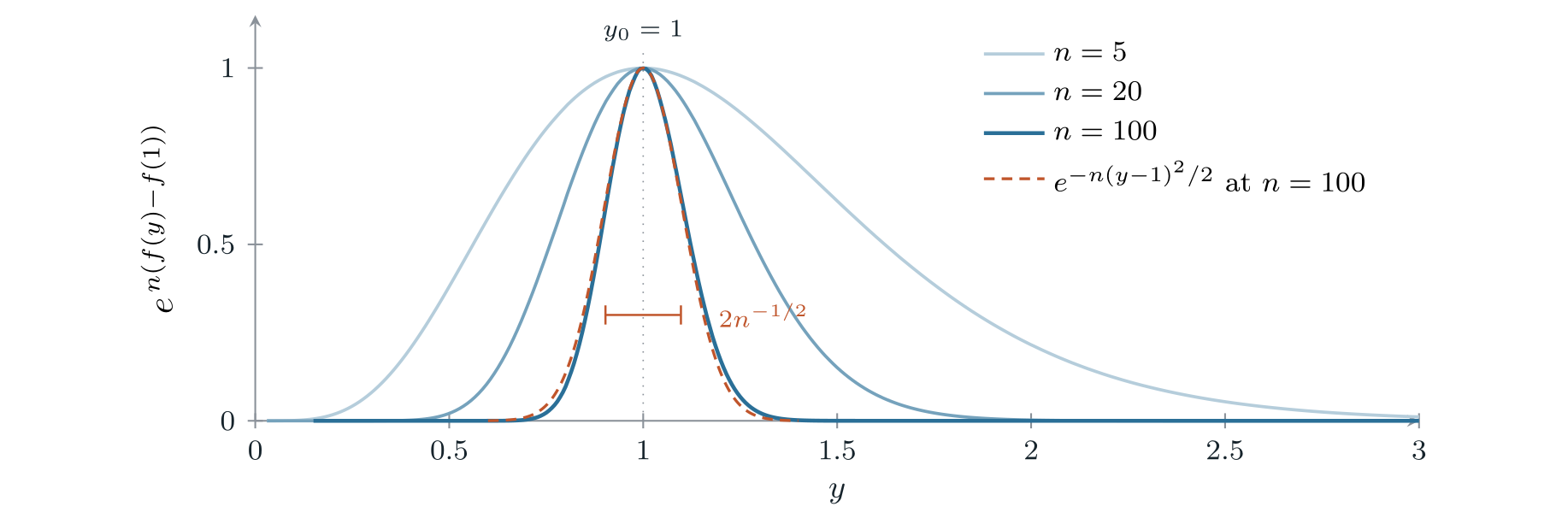
Laplace’s method is used when solving a real integral of the form $\int e^{nf(x)}dx$. Heuristically, as $n \to \infty$, any contribution of $f(x)$ outside of a maximum, $x_0$ becomes vanishingly small, as we see in $\eqref{eq:laplace_general}$. In the proof of $\eqref{eq:stirling}$ $f$ will be constructed from the Gamma function $\Gamma(x) = \int_0^\infty t^{x-1}e^{-t}dt$. The figure below shows this concentration happening.
Proof.
Step 1: We take for granted that $\Gamma(n+1) = n!$. We want to find the $f$, so that
$x^{n}e^{-x} = e^{n\log(x)-x}$.
Step 2: We will want to change variables $x = ny$ so that $n\log(x)-x = n \log(ny) - ny = n (\log (n) + \log(y) - y)$. Because we are interested in a maximum of $f$, we can ignore the $n \log(n)$ and our candidate is $f(y) = \log(y) - y$. The integral we study is thus,
We note $f’(y) = \tfrac{1}{y} - 1$ and $f’‘(y) = - \tfrac{1}{y^2}$, so $f$ has a global maximum at $y_0 = 1$.
We Taylor expand $f$:
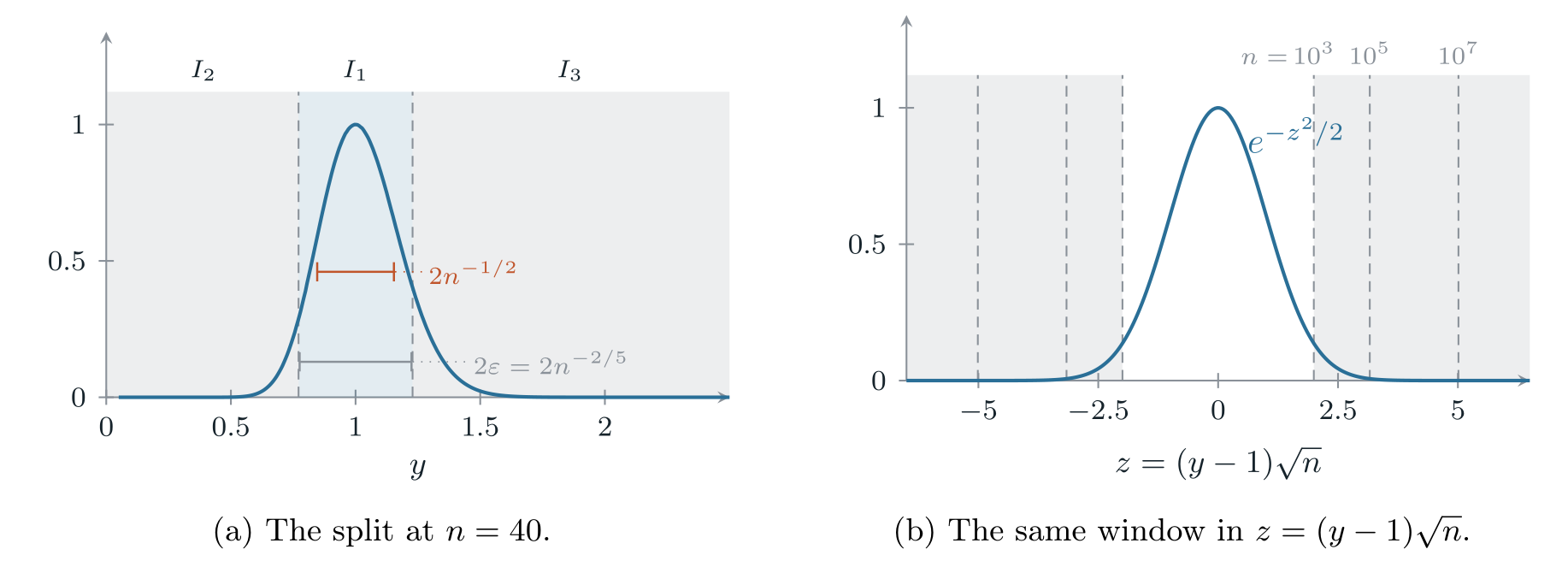
Step 2: Let $\vep > 0$. We split the integral up
The figure below shows this split and the two scales that make it work.
The first term, under the substitution $y = 1 + \frac{z}{\sqrt{n}}$ is
We need to take $\vep \to 0$, and we have $O(\vep^3)$ in the exponent, so lets set $\vep = n^{-2/5}$. We make this choice in order that $n \vep^3 = n^{-1/5} \to 0$ as $n \to \infty$. Then,
Using the Gaussian integral we get the desired approximation
Step 4: However, we must also show that $I_2(n)$ and $I_3(n) \to 0$. To do so, we use the fact that $f(1) = -1$ is a global maximum and $f(y)$ is strictly increasing on $(0,1)$ and strictly decreasing on $(1, \infty)$. Set $\delta = \min(-1-f(1-\vep), -1-f(1+\vep)) > 0$ so that $f(y) < -1 - \delta$ for all $y \in (0,1 - \vep) \cup (1 + \vep,\infty)$. Note that,
So,
where we have used the fact that $\int_0^\infty ye^{-y} dy = 1$ and the integrand is strictly positive. Similarly, $I_3(n) \leq e^{(n-1)(-1-\delta)}$. Now, we must achieve a bound solely in $n$. Using the Taylor expansion of $\log(1+\vep)$
whereas,
so actually $\delta = \vep - \log(1+\vep)$. We then bound, $g(t) = t - \log(1+t)$.
Since $\frac{u}{1+u} \leq u$, $t - \log(1+t) \leq \frac{t^2}{2}$. Additionally, since $\frac{u}{1+u} \geq \frac{u}{1+t}$, $t - \log(1+t) \geq \frac{t^2}{2(1+t)}$. Plugging in $\vep = n^{-2/5}$ we have, $\delta \geq \frac{n^{-4/5}}{4}$. So,
and similarly with $I_3(n)$. These both can be absorbed into the the $o(1)$ term in Equation $\eqref{eq:stirling_center}$ and we are done. $\blacksquare$